Our Financial Future: Nature’s Not Just A Pretty Face
Our financial futures are supposed to be in our hands.Insurance is supposed to be boring.
You pay your premium and hope you never need it.
It sits quietly in the background whilst life carries on.
The problem is, your insurer is also hoping you never need them. Their business models work on the assumption that a large proportion of their clients will never make a claim.
So what happens when you claim suddenly becomes much more likely?
The price you pay goes up… and eventually you could even be refused insurance, and suddenly, there’s a lot more on the line.
When the Climate Crisis Becomes an Insurance Crisis…
We are becoming more and more exposed to freak weather events and natural disasters.
What used to be a once-in-a-generation horror, is becoming a regular occurrence in some parts of the world.
Premiums are rising sharply in climate-exposed regions. Some homes are becoming uninsurable. Major firms are warning that climate breakdown could destabilise financial systems.
Research highlighted by Loughborough University has described climate change as an emerging insurance crisis. Conservation groups like World Wildlife Fund point to the combined impact of climate change and nature loss. Even insurance giant Allianz has warned that unchecked climate risk could threaten the foundations of capitalism.
Insurance only works when the world is predictable, and predictability depends on nature.
Nature for Nature’s Sake
There’s a temptation to view conservation as a “nice to have”.
Those of us are so (rightly) passionate about protecting nature for nature’s sake, because it’s beautiful and as much entitled to a life on this Earth as humans, can have a tendency to forget that much of the time, what drives decision making around the world, is money.
There is, in fact, a VERY strong financial argument for conserving our planet, and it’s not JUST about insurance.
The Shock Absorbers We Removed
For most of human history, ecosystems quietly reduced risk for us.
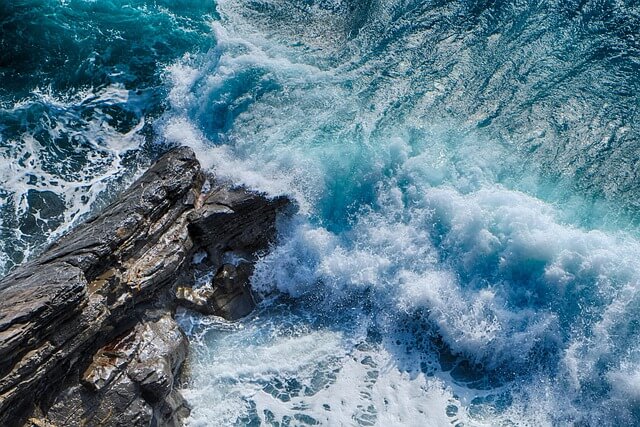
Wetlands slowed floodwaters.
Saltmarshes and coral reefs softened the impact of storm surges.
Forests stabilised slopes and cooled local climates.
Peatlands regulated water flow after heavy rain.
Yet, somehow, we don’t think of them as infrastructure. They are simply landscapes.
When we alter the natural world, we remove those buffers. Water moves faster. Storm damage intensifies. Wildfire spreads further.
Rebuilding after repeated flooding is expensive. Building higher sea walls is expensive. Retrofitting drainage systems is expensive.
Maintaining healthy ecosystems, by comparison, is often remarkably cost-effective.
Nature was doing the job for free.
Feeding the 8.3 Billion
So many of the resources we rely on come from nature, from food, to medicine, to timber. The clothes we wear on our backs, the energy that fuels our homes and so much more relies on functioning ecosystems.
Perhaps the most obvious financial benefit is food production.
Food production depends on:
- Pollinators
- Healthy soils
- Stable rainfall patterns
- Genetic diversity
When insect populations decline, crop yields wobble.
When soils erode, productivity falls.
When droughts intensify, supply chains tighten.
Pollinators alone underpin crops worth hundreds of billions globally. That’s not a wildlife statistic. That’s an economic one.
Protecting nature is essential in protecting agriculture, as well as the other industries producing so many of the resources we’ve come to rely on.
Earth: The Foremost Expert in Carbon Sequestration
Forests, peatlands, seagrass meadows, kelp forests and saltmarshes absorb and store carbon.
When these habitats are degraded, two things happen:
- They stop capturing carbon.
- They release what they’ve already stored.
That accelerates warming, which intensifies storms, floods and fires.
We call it a positive feedback loop- releasing more carbon leads us to release even more carbon.
We often talk about carbon capture as a technological frontier. But ecosystems have been performing large-scale carbon sequestration for hundreds of millions of years.
We are dismantling that system faster than we are building replacements.
The Invisible Systems Holding Everything Up
Beyond floods and food lies something even more fundamental.
The biosphere regulates:
- Oxygen and carbon dioxide levels
- Nutrient cycling (nitrogen, phosphorus)
- Freshwater filtration
- Climate feedback mechanisms
In short, it’s thanks to planet Earth’s systems that we have oxygenated air to breath, water to drink, plants that grow and form the basis of almost every food chain on the planet, and a stable climate that we can safely exist in.
These systems are so constant we barely notice them…until they destabilise.
We can adapt to accommodate a few freak storm events, the odd year of drought or a warm summer or two, but our financial systems aren’t built to survive complete unpredictability.
The Value We Don’t Account For
Some economic analyses suggest that if we tried to artificially replicate the services nature provides- pollination, water purification, climate regulation, soil formation- the cost would exceed global GDP.
In other words, our ecosystems may be worth more money than than everyone on the entire planet makes collectively in one year.
Yet we rarely record its degradation as a financial loss. We still view nature as a “nice to have”.
We Can’t Replace What We Are Losing
You might be forgiven for thinking that the solution is to build a technology that can do these jobs for us.
We have tried.
We failed.
In the early 1990s, scientists attempted to create a sealed, self-sustaining artificial ecosystem inside a structure called Biosphere 2.
It was ambitious. It was well funded. It involved serious scientific oversight.
Oxygen levels fluctuated unpredictably. Nutrient cycles became unstable. Ecological interactions proved far more complex than anticipated.
Even at a tiny scale, recreating Earth’s life-support systems is seemingly impossible.
We are currently stress-testing the Biosphere 1, or planet Earth as we know it.
There is no backup dome. We only have this chance.
Nature…and Our Financial Future
Conservation is often framed as emotional. Ethical. Idealistic. Something for the wealthy to occupy their time.
But this is a dangerous mindset.
Conservation isn’t just about saving species. It’s about keeping the systems we depend on stable and functioning to protect and secure the financial futures of everyone on this planet.
One Wild Thing
For most of us, global financial markets are not within our control, but you can support the natural systems in your own patch of the world.
One simple thing you can do: make space for water and wildlife where you live.
That might mean replacing paving with grass, planting native trees, letting part of your garden grow wilder, or supporting local conservation projects.
Every little piece plays its role in securing our future.

You May Also Like
How to See Tigers in Nepal: A Guide to Finding the Bengal Tiger

Discover Wild Animals in the UK